What Is JWT Authentication ?
Authentication is a fundamental part of modern web application development. Whether a user logs in to an e-commerce platform, accesses a dashboard, or uses a mobile application, the system needs a reliable way to identify the user and control access to protected resources.
JSON Web Token (JWT) is a widely used standard for representing information about a user or another entity in a compact, transferable format. It is commonly used in authentication systems, API access, and communication between services.
For developers working with React, Node.js, Express, mobile applications, or distributed systems, understanding JWT is essential. However, implementing JWT-based authentication correctly requires more than generating a token after login. Developers must understand token structure, signature verification, expiration, storage, and common security risks.
What Is a JSON Web Token ?
JSON Web Token, commonly called JWT and pronounced “jot,” is an open standard defined in RFC 7519. It provides a compact, URL-safe format for transmitting claims between parties. These claims can be protected through digital signatures or encryption, depending on the JWT format used.
In typical web applications, a signed JWT carries information that a server can verify before allowing access to protected resources.
A JWT generally looks like this:
xxxxx.yyyyy.zzzzz
A signed JWT contains three Base64URL-encoded components separated by periods:
- Header
- Payload
- Signature
The token can be sent with HTTP requests so the receiving server can validate it and determine whether the request should be allowed.
Understanding the Three Parts of a JWT
Header
The header identifies the token type and the cryptographic algorithm used to protect it.
Example:
{
  "alg": "HS256",
  "typ": "JWT"
}
Here, HS256 represents HMAC using SHA-256. The server must independently enforce its accepted algorithms rather than blindly trusting the algorithm named in an incoming token.
Payload
The payload contains claims, which are statements about the subject or other relevant information.
Example:
{
  "sub": "12345",
  "role": "admin",
  "iat": 1792684800,
  "exp": 1792688400
}
In this example:
subidentifies the subject.rolerepresents an application-specific role claim.iatindicates when the token was issued.expspecifies when the token expires.
The example timestamps are illustrative.
Important: Base64URL encoding is not encryption. Anyone who obtains a typical signed JWT can decode its header and payload. Never place passwords, secret keys, or sensitive personal information in an ordinary signed JWT payload.
Signature
The signature protects the integrity of the token. With a properly configured signing algorithm, the server can detect whether the protected content has been altered.
For example, with HMAC-SHA-256, the signature is generated using the encoded header, encoded payload, and a secret key.
If someone changes the payload without producing a valid signature, the server should reject the token.
Steps in the JWT Authentication Process
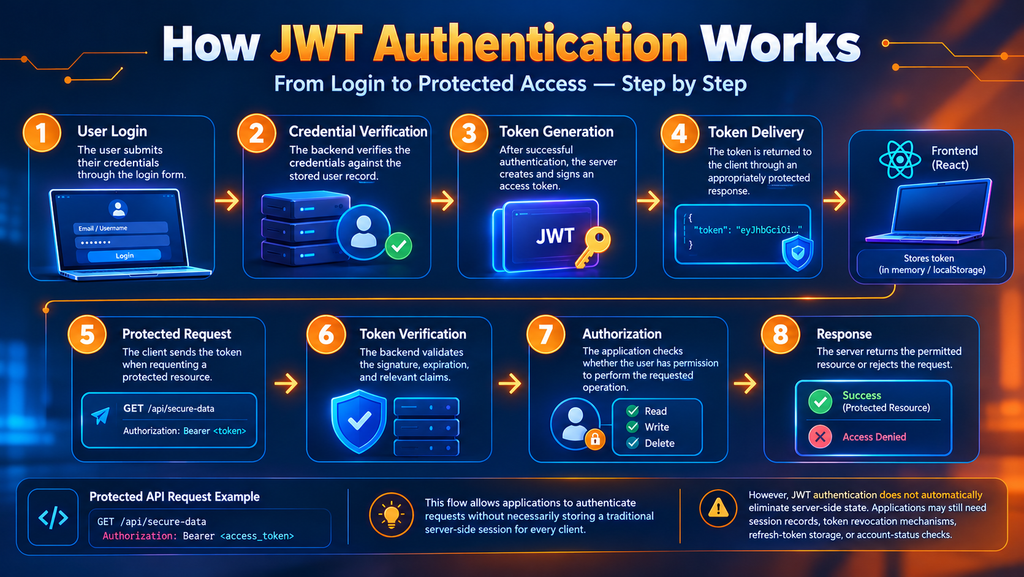
Consider a web application built with React on the frontend and Node.js with Express on the backend.
The authentication process generally follows these steps:
- User login: The user submits their credentials through the login form.
- Credential verification: The backend verifies the credentials against the stored user record.
- Token generation: After successful authentication, the server creates and signs an access token.
- Token delivery: The token is returned to the client through an appropriately protected response.
- Protected request: The client sends the token when requesting a protected resource.
- Token verification: The backend validates the signature, expiration, and relevant claims.
- Authorization: The application checks whether the authenticated user has permission to perform the requested operation.
- Response: The server returns the permitted resource or rejects the request.
A protected API request commonly includes this HTTP header:
Authorization: Bearer <access_token>
This flow allows applications to authenticate requests without necessarily storing a traditional server-side session for every client.
However, JWT authentication does not automatically eliminate server-side state. Applications may still need session records, token revocation mechanisms, refresh-token storage, or account-status checks.
Authentication vs Authorization: Why JWT Alone Is Not Enough
One common implementation mistake is treating a valid JWT as permission to access every resource.
Authentication answers: Who is making the request?
Authorization answers: What is this user allowed to do?
For example, a token may identify a user as an administrator. The backend must still check whether that user is authorized to perform the requested action and access the specific resource.
A secure implementation should:
- Validate the JWT before trusting its claims.
- Check permissions on the backend.
- Verify resource ownership or institutional boundaries.
- Deny access when permissions are missing.
- Avoid relying on frontend route protection as the only security control.
For applications using Role-Based Access Control (RBAC), JWT claims can provide identity context, while the authorization layer determines whether the relevant permissions are currently valid.
If roles or permissions change during a token’s lifetime, applications must account for potentially stale claims through short token lifetimes, server-side checks, token versioning, or other appropriate mechanisms.
Access Tokens vs Refresh Tokens
Many authentication systems use two token types with different purposes.
Access token: Sent to protected APIs to authorize access. It is typically short-lived.
Refresh token: Used to obtain a new access token without requiring the user to log in again, subject to the application’s session and security policies.
Refresh tokens should be protected carefully. Secure implementations commonly use rotation, detect reuse where appropriate, and support revocation when a session ends or a token is compromised.
A refresh token should not simply be treated as an ordinary access token with a longer expiration. Its use must be restricted to the token-refresh process.
Common JWT Authentication Mistakes
JWTs are useful, but incorrect implementation can introduce serious vulnerabilities.
Storing tokens insecurely
Browser storage choices have different security trade-offs. JavaScript-accessible storage, including localStorage, can expose tokens if an attacker executes malicious JavaScript through an XSS vulnerability.
HttpOnly cookies can prevent JavaScript from reading a cookie, but cookie-based authentication also requires appropriate Secure, SameSite, and CSRF protections.
Using weak or exposed secrets
A weak signing secret can make it easier for an attacker to forge tokens. Secrets should be generated with sufficient randomness, stored securely, and rotated when necessary.
Ignoring token expiration
Long-lived access tokens increase the period during which a stolen token may remain usable. Expiration should reflect the application’s risk and usability requirements.
Trusting token contents without verification
Decoding a JWT does not establish that it is valid. The server must verify the signature or authenticated encryption and validate the relevant claims before trusting its contents.
Assuming logout automatically invalidates a token
A self-contained JWT may remain valid until it expires unless the application implements a revocation or session-validation mechanism. Logout should invalidate the application’s session appropriately, and refresh tokens should be revoked when required.
Skipping HTTPS
Tokens should be transmitted only over protected connections. HTTPS helps prevent interception of credentials and bearer tokens in transit.
Security guidance in RFC 8725 and the OWASP JWT Cheat Sheet provides further recommendations for robust implementations.
When Should Developers Use JWT ?
JWT can be useful for:
- Securing APIs used by web and mobile applications.
- Passing authenticated identity information between services.
- Implementing access tokens in OAuth-based systems.
- Supporting distributed applications that need verifiable claims.
- Integrating with identity providers that issue JWT-based tokens.
However, JWT is not the ideal solution for every application. Traditional server-side sessions can be simpler when centralized session control, immediate revocation, and straightforward logout behavior are priorities.
The choice should depend on the application’s architecture, security requirements, and operational needs rather than the assumption that JWT is always better.
Conclusion
JSON Web Tokens have become an important component of modern authentication and API development. Their compact format and cryptographic protections make them useful for carrying verifiable claims between applications and services.
Nevertheless, a JWT is not a complete authentication system by itself. Secure implementation requires proper token generation, signature verification, expiration handling, protected storage, authorization checks, and a clear strategy for logout and revocation.
For developers, understanding these fundamentals makes it easier to build applications that are both scalable and secure.
As web applications continue to integrate distributed services and identity platforms, knowing how JWT works—and when not to use it—remains a valuable technical skill.
About the Author