Artificial intelligence has entered a new phase of development.
For several years, much of the progress in generative artificial intelligence has been associated with increasingly large models. Large Language Models (LLMs) have demonstrated remarkable capabilities in natural language understanding, content generation, coding, reasoning, summarization, translation, and information processing.
The scale of these models has been an important part of the evolution of modern AI. However, as organizations move from experimentation to widespread deployment, another question is becoming increasingly important:
Does every AI task require a large, general-purpose model?
The answer is increasingly no.
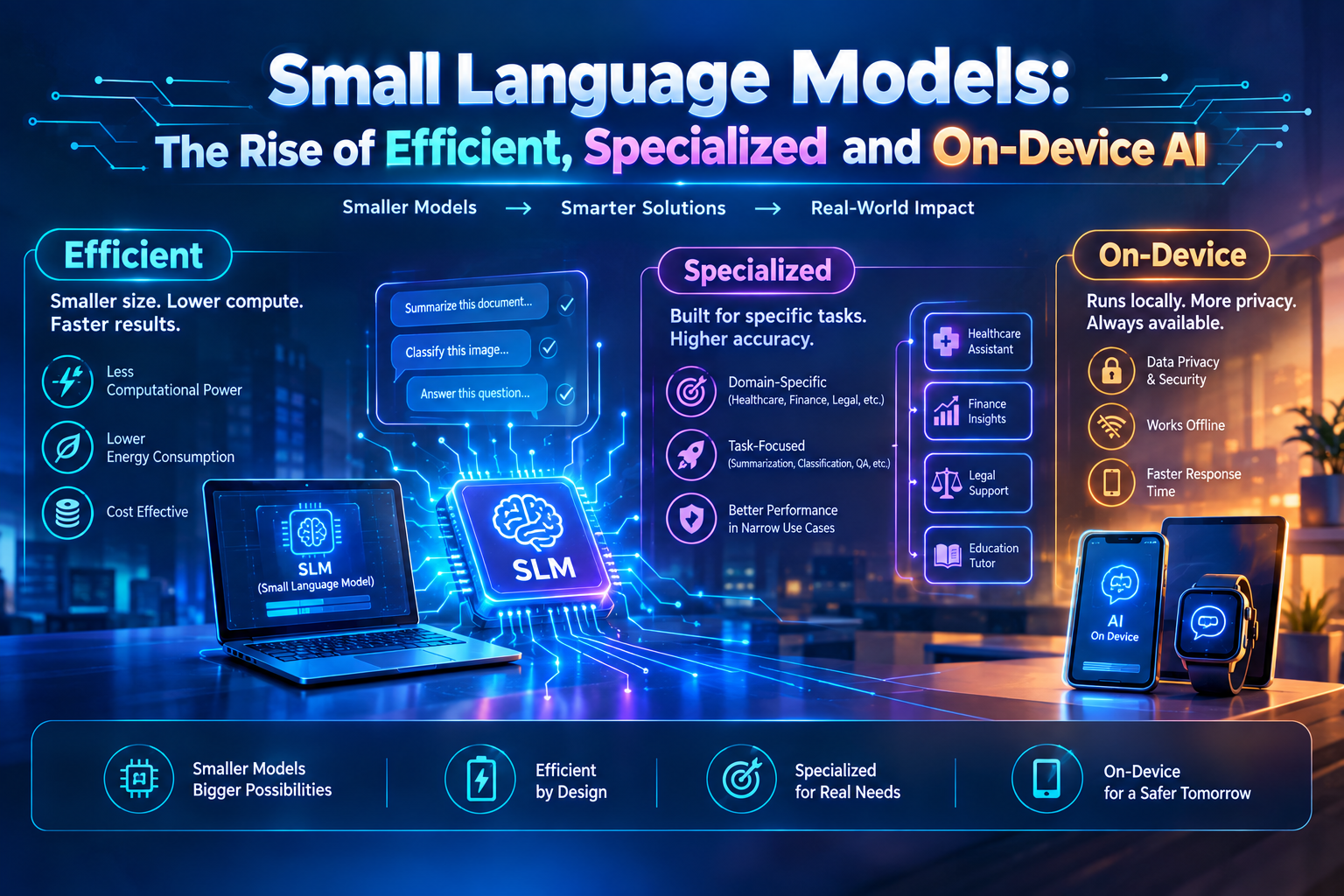
A growing part of the AI industry is moving toward Small Language Models (SLMs) and other specialized models designed to perform specific tasks with fewer computational resources.
This does not represent the end of Large Language Models. Instead, it represents a change in how AI systems are being designed.
Rather than relying on a single model for every possible task, organizations can increasingly use different models according to the complexity, sensitivity, latency, and computational requirements of each workload.
A simple task may be handled by a small model.
A specialized business task may be handled by a domain-specific model.
A highly complex reasoning problem may still be routed to a larger foundation model.
This emerging approach is creating a more diverse AI ecosystem in which model size, specialization, deployment location, and efficiency become architectural decisions rather than simply measures of intelligence.
The development is particularly relevant in 2026. Gartner has identified domain-specific language models as one of its Top Strategic Technology Trends for 2026, while its research on Small Language Models highlights their potential to improve cost predictability, security, and control as enterprise AI adoption expands.
The movement toward smaller and more specialized AI models therefore reflects a broader transition: from building increasingly powerful models to building AI systems that are appropriately sized for the work they need to perform.
Understanding Small Language Models
Small Language Models are AI models designed to process and generate language while requiring substantially fewer computational resources than large general-purpose language models.
There is no universally accepted parameter count that defines an SLM.
The distinction is generally based on the model’s relative size, computational requirements, deployment environment, and intended purpose.
Some SLMs may contain millions of parameters, while others may contain billions. What makes them “small” is their relative efficiency compared with much larger models designed for broad and highly complex workloads.
IBM describes SLMs as more compact models that require less memory and computational power than large models, making them particularly suitable for resource-constrained environments such as edge devices and local applications.
The fundamental objective is not simply to make an AI model smaller.
The objective is to achieve an appropriate balance between:
- Intelligence
- Accuracy
- Computational efficiency
- Latency
- Cost
- Privacy
- Security
- Deployment flexibility
This distinction is important.
A smaller model that cannot perform its intended task reliably has little practical value.
The real objective is therefore to identify the smallest sufficiently capable model for a particular workload.
From Model Scaling to Model Specialization
The development of modern AI has been heavily influenced by scaling.
Increasing the number of model parameters, training data, and computational resources has produced increasingly capable foundation models.
Large models can perform a wide variety of tasks without requiring separate models for every application.
However, general-purpose capability can also introduce unnecessary computational overhead.
Consider a simple enterprise task such as classifying customer messages into:
- Billing
- Technical support
- Account management
- General inquiry
Such a task may not require the reasoning capabilities of a frontier-scale model.
A specialized model trained or optimized for classification could potentially perform the task more efficiently.
The same principle can apply to:
- Document classification
- Sentiment analysis
- Data extraction
- Text summarization
- Translation
- Content moderation
- Internal search
- Customer support routing
- Structured information extraction
This creates an important shift in AI engineering.
Instead of asking:
“Which model is the most powerful?”
organizations can increasingly ask:
“Which model is appropriate for this workload?”
That is a fundamentally different approach to AI architecture.
Why Bigger Does Not Always Mean Better
Large models are extremely useful for complex and open-ended problems.
They can reason across multiple domains, work with large contexts, generate sophisticated content, and perform complex programming or analytical tasks.
However, model size alone does not guarantee the best solution for every application.
A model must operate within the constraints of the environment in which it is deployed.
For enterprise systems, these constraints may include:
- Response-time requirements
- Infrastructure capacity
- AI inference costs
- Data privacy
- Regulatory requirements
- Network availability
- Energy consumption
- Hardware limitations
- Number of requests
- Required level of accuracy
For a high-volume application, even a small difference in inference cost can become significant when multiplied across millions of requests.
This is one reason model selection is becoming an important part of enterprise AI strategy.
Gartner’s 2026 research notes that AI adoption is creating increasing cost, data, compliance, and governance concerns and identifies purpose-sized SLMs as one approach for addressing these challenges.
Small Language Models and Edge AI
One of the most significant opportunities for SLMs is Edge AI.
Edge AI refers to artificial intelligence processing performed closer to the location where data is generated.
Instead of sending all data to a centralized cloud service, some processing can occur directly on the device or at a nearby edge computing environment.
This is particularly useful when:
- Network connectivity is limited.
- Latency must be extremely low.
- Data is sensitive.
- Large amounts of data are generated continuously.
- Cloud processing is economically inefficient.
Consider an industrial camera monitoring a production line.
Sending every image to a remote cloud server could require substantial bandwidth.
An edge-based AI system could analyze images locally and transmit only relevant information.
For example:
Camera → Local AI Model → Defect Detected → Alert
Rather than:
Camera → Cloud → AI Processing → Response → Factory
The local architecture can reduce communication requirements and improve response time.
Gartner’s 2026 research on small reasoning models specifically points toward on-device intelligence and edge computing as important areas where smaller models can provide task-level AI capabilities.
The Relationship Between SLMs and LLMs
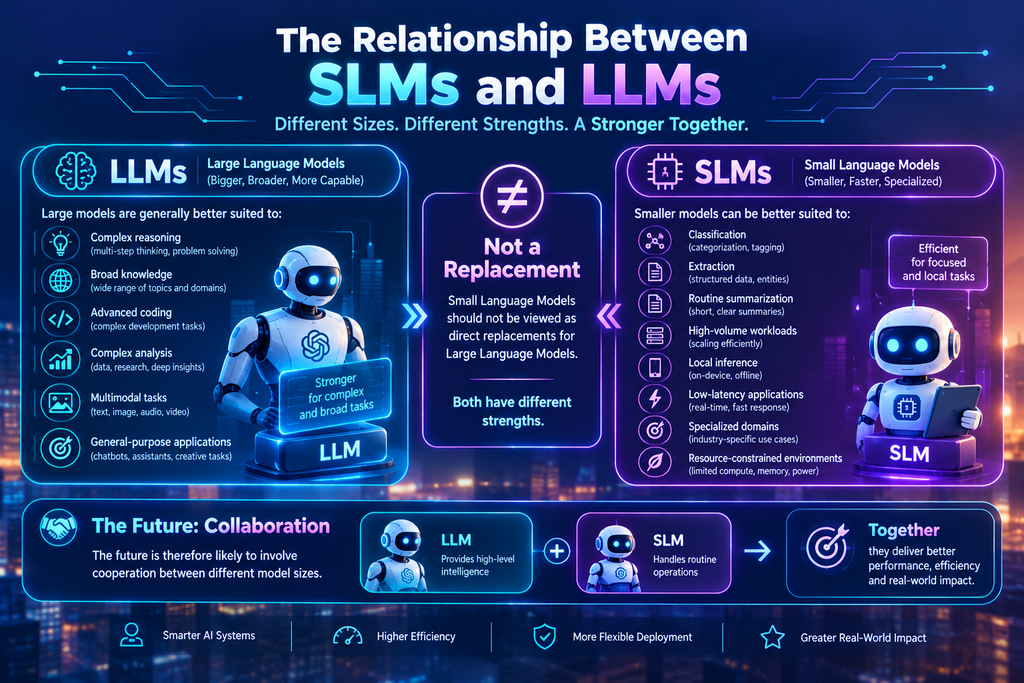
Small Language Models should not be viewed as direct replacements for Large Language Models.
Both have different strengths.
Large models are generally better suited to:
- Complex reasoning
- Broad knowledge
- Advanced coding
- Complex analysis
- Multimodal tasks
- General-purpose applications
Smaller models can be better suited to:
- Classification
- Extraction
- Routine summarization
- High-volume workloads
- Local inference
- Low-latency applications
- Specialized domains
- Resource-constrained environments
The future is therefore likely to involve cooperation between different model sizes.
A large model may provide high-level intelligence while smaller models handle routine operations.
The Strategic Importance of Small Language Models
The rise of SLMs should therefore not be interpreted as a temporary reaction to the high cost of large models.
It reflects a broader maturation of AI engineering.
As AI becomes infrastructure rather than experimentation, organizations need solutions that are:
- Efficient
- Predictable
- Secure
- Specialized
- Scalable
- Deployable
- Economically sustainable
Gartner’s 2026 technology outlook reflects this broader transition, with domain-specific language models positioned alongside AI infrastructure, confidential computing, multi-agent systems, physical AI, and AI security as strategic technology developments.
At the same time, Gartner forecasts substantial growth in specialized and domain-specific generative AI models in 2026, indicating that the market is moving beyond a single-model approach toward a broader ecosystem of specialized AI capabilities.
Conclusion
The evolution of artificial intelligence is entering a new stage.
The first major phase of modern generative AI demonstrated the power of large foundation models. These systems established that increasingly capable models could perform tasks that previously required specialized software or human intervention.
The next phase is likely to focus increasingly on efficiency, specialization, deployment, and economics.
Small Language Models are an important part of this transition.
They provide an approach for building AI systems that can operate with lower computational requirements, reduced latency, greater deployment flexibility, and stronger specialization.
Their importance extends beyond simply reducing model size.
SLMs can enable AI to move closer to users, devices, enterprise infrastructure, and physical environments. They can support edge computing, private AI, specialized business applications, high-volume workloads, and local inference.
At the same time, large models will continue to play an important role in advanced reasoning and general-purpose AI.
The emerging architecture is therefore not a choice between large models and small models.
It is the intelligent combination of both.
A mature AI system may use a small model for routine tasks, a specialized model for domain-specific operations, and a large model when advanced reasoning is required.
This approach changes the fundamental question surrounding AI.
The future is not necessarily about building the largest possible model.
It is about building the most appropriate AI system.
As AI becomes increasingly integrated into enterprise software, edge devices, industrial environments, and everyday applications, the ability to select the right model for the right workload will become as important as the model’s raw intelligence.
Small Language Models are therefore not simply a smaller version of the AI systems that came before them.
They represent a broader movement toward efficient, specialized, distributed, and purpose-built intelligence — a direction that is likely to play an increasingly important role in the next generation of artificial intelligence.
About the Author