Introduction
Application Programming Interfaces (APIs) have become a fundamental component of modern software architecture. They enable applications, services, databases, and external platforms to communicate through defined interfaces, allowing software systems to exchange information and execute operations without requiring direct access to one another’s internal implementation.
As software environments become increasingly interconnected, APIs also introduce important security considerations. Every API endpoint that exposes data or functionality creates a potential entry point that must be designed, implemented, and maintained with appropriate security controls. An API may function correctly from an operational perspective while still exposing sensitive information, permitting unauthorized actions, or allowing excessive resource consumption.
API security is therefore not limited to protecting an endpoint with a password or token. It involves a coordinated set of architectural principles, identity verification mechanisms, access-control policies, data-validation practices, cryptographic protections, monitoring capabilities, and operational safeguards.
Understanding these mechanisms is essential for building reliable applications in which communication between software components remains controlled, authenticated, and resistant to misuse.
Understanding API Security
API security refers to the technologies, policies, and architectural practices used to protect APIs against unauthorized access, data exposure, manipulation, service disruption, and other forms of abuse.
An API typically defines the operations that a client can perform, the information it can submit, and the responses it may receive. Security determines which clients are permitted to perform those operations, what information they can access, and under which conditions a request should be accepted or rejected.
For example, an application may expose separate endpoints for viewing a customer profile, updating account information, generating reports, and managing administrative settings. Although these endpoints belong to the same application, they do not necessarily require identical access permissions.
A secure API must distinguish between legitimate requests and requests that exceed the authority of the requesting identity. This distinction must remain valid even when a client modifies request parameters, changes resource identifiers, replays previously captured requests, or attempts to bypass the intended application workflow.
API security consequently operates across several layers, including transport security, identity management, authorization, input processing, business logic, infrastructure protection, and continuous monitoring.
The Security Architecture of an API
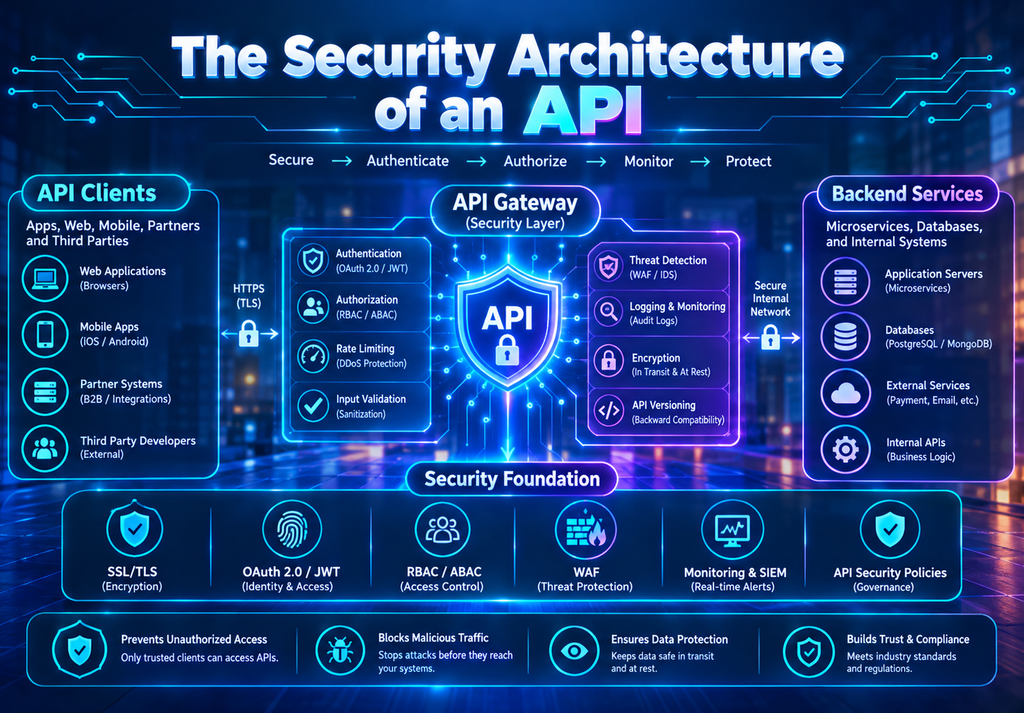
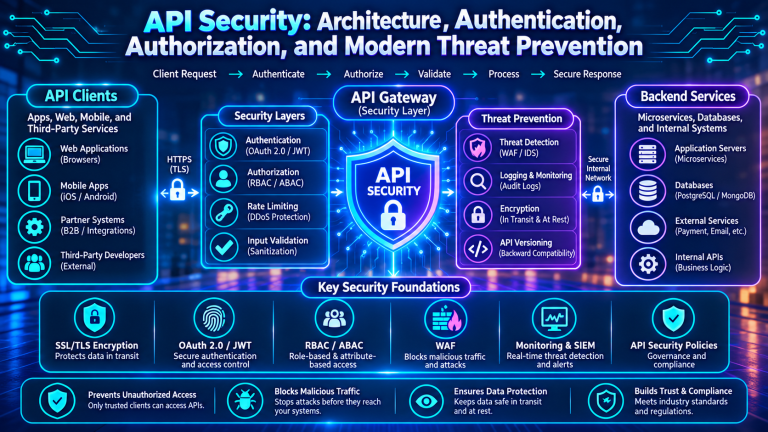
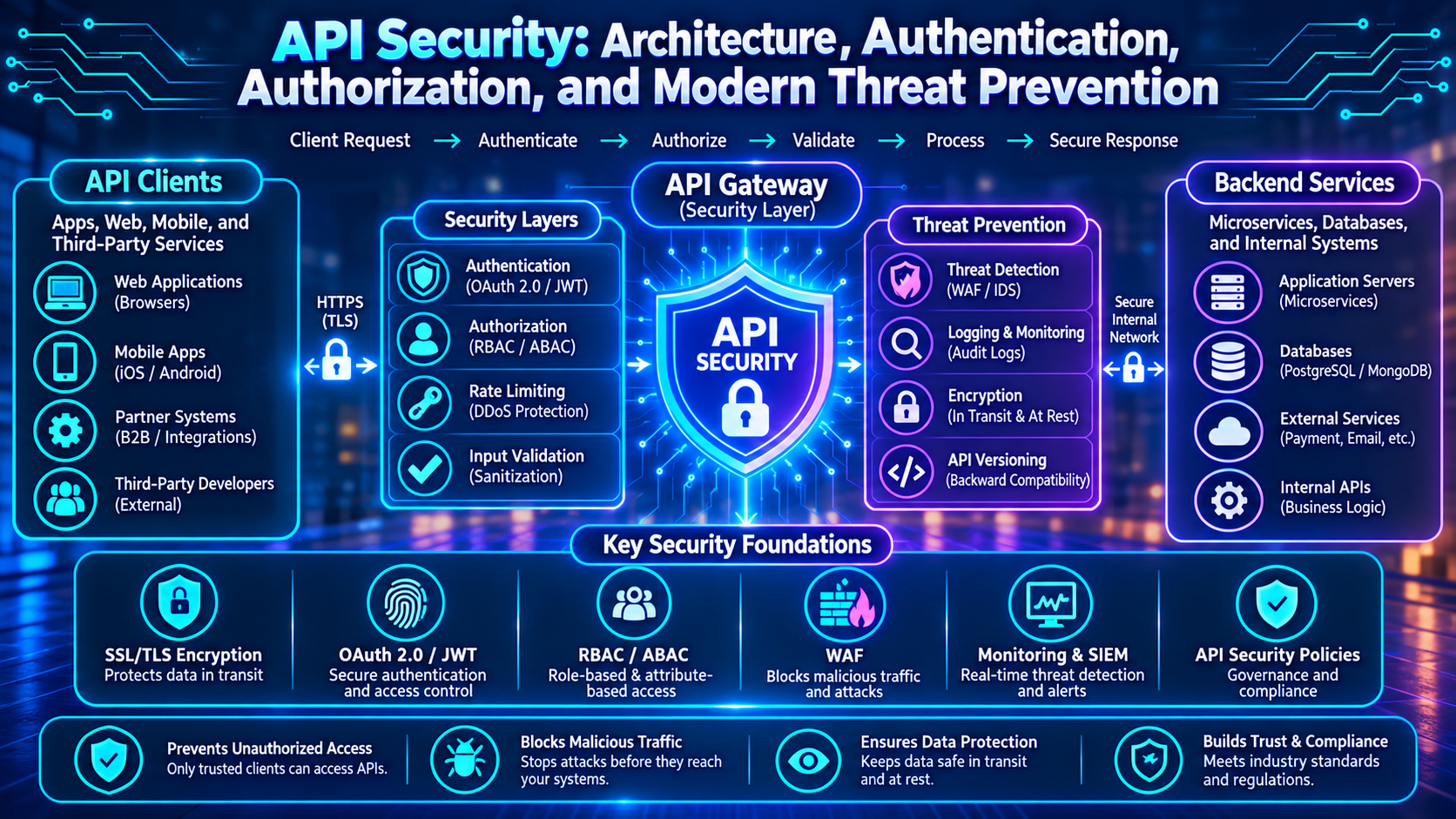
An API security architecture defines how requests are received, evaluated, processed, and monitored throughout their lifecycle.
A typical architecture may include a client application, an API gateway, an authentication service, authorization policies, application services, databases, and monitoring infrastructure. Each component has a specific responsibility, but the overall security outcome depends on how these components interact.
The client initiates a request containing the required endpoint, parameters, headers, and payload. The API gateway or application server receives the request and applies the relevant preliminary controls. These may include transport-security requirements, request-size restrictions, rate limits, token validation, and routing policies.
Authentication mechanisms establish the identity associated with the request. Authorization controls then determine whether that identity is permitted to perform the requested operation on the specified resource.
The application subsequently validates the request, executes the permitted business operation, and returns an appropriate response. Security monitoring records relevant events without unnecessarily exposing credentials, personal information, or other sensitive data.
This architecture should not assume that any individual component can guarantee complete protection. An API gateway may reject malformed requests, for example, but it cannot necessarily determine whether an authenticated customer is entitled to access a particular invoice. That decision may require application-level authorization based on ownership, organizational membership, or other business rules.
Effective API security therefore combines centralized controls with security checks inside the application itself.
Authentication: Establishing Identity
Authentication is the process of verifying the identity associated with a request. It answers the question: who or what is making this request?
APIs may authenticate human users, mobile applications, server-to-server clients, automated services, or machine identities. The appropriate mechanism depends on the nature of the client, the sensitivity of the data, and the required level of trust.
API Keys
An API key is a credential used to identify an application or client. It is commonly employed for service identification, usage tracking, and access to certain public or partner APIs.
However, an API key should not automatically be treated as proof of a human user’s identity or as sufficient authorization for sensitive operations. If a key is exposed through source code, client-side applications, logs, or public repositories, an unauthorized party may be able to reuse it.
API keys should therefore be scoped appropriately, protected from unnecessary exposure, rotated when required, and revoked when compromised. For sensitive APIs, they should be combined with stronger identity and authorization mechanisms.
Token-Based Authentication
Token-based authentication allows a client to present a credential representing an authenticated identity or an authorized client application.
OAuth 2.0 is an authorization framework frequently used to grant applications controlled access to resources. OpenID Connect builds on OAuth 2.0 to provide an identity layer for authentication.
JSON Web Tokens (JWTs) are one possible format for representing claims about an identity or authorization context. A JWT may contain information such as an issuer, subject, audience, and expiration time.
A signed token can provide integrity protection, but its contents are not necessarily confidential. Ordinary signed JWTs can generally be decoded by anyone who obtains them. Sensitive information should not be placed in a token unless appropriate encryption and handling mechanisms are used.
Token validation must include appropriate checks for the signing algorithm, signature, issuer, audience, expiration, and other required claims. Merely decoding a token or checking whether it contains a user identifier is insufficient.
Session-Based Authentication
Session-based authentication maintains server-side state associated with an authenticated user. The client typically presents a session identifier, often through a secure cookie, while the server retrieves the corresponding session information.
This approach can support centralized session invalidation and straightforward control over authenticated sessions. However, it requires appropriate session management, protection against session fixation, secure cookie configuration, and suitable defenses against cross-site request forgery when applicable.
No authentication mechanism is inherently secure in every context. Its effectiveness depends on implementation quality, credential protection, lifecycle management, and the surrounding authorization architecture.
Authorization: Controlling Access to Resources
Authentication establishes identity, whereas authorization determines what that identity is allowed to do.
This distinction is one of the most important principles in API security. A request can come from a successfully authenticated user and still be unauthorized.
Authorization decisions may depend on the user’s role, assigned permissions, organizational membership, resource ownership, subscription level, or the specific action being requested.
Role-Based Access Control
Role-Based Access Control (RBAC) associates permissions with roles, which are then assigned to users or other identities.
For example, a system may define administrator, manager, and standard-user roles. Each role receives a defined set of permissions appropriate to its responsibilities.
RBAC simplifies permission management in systems where responsibilities are reasonably stable and can be grouped into predefined roles. However, role checks alone may not be sufficient when access depends on individual resources or contextual conditions.
Attribute-Based Access Control
Attribute-Based Access Control (ABAC) evaluates access decisions using attributes associated with the user, resource, requested operation, and environment.
A policy might permit a manager to access records belonging to their own department while preventing access to records owned by another department. The decision depends on the relationship between multiple attributes rather than only on a predefined role.
ABAC can support more granular policies, although its complexity requires clear policy definitions, reliable attribute data, and careful testing.
Object-Level Authorization
Object-level authorization determines whether a user can perform an operation on a particular resource.
Consider an endpoint that retrieves an invoice using an invoice identifier. Authentication may confirm that the requester is a valid customer, but it does not establish that the invoice belongs to that customer.
If the application retrieves the invoice solely by its identifier without checking ownership or an equivalent permission, one customer may gain access to another customer’s information.
This class of vulnerability is commonly associated with Broken Object Level Authorization (BOLA), previously often discussed as Insecure Direct Object Reference (IDOR) in application-security contexts.
Preventing it requires authorization checks that evaluate the actual resource and the requested operation. Random or unpredictable identifiers can provide limited defense in some situations, but they do not replace authorization.
Security Testing Across the API Lifecycle
API security testing should be integrated into development and operational processes.
Static analysis can identify certain insecure coding patterns before deployment. Dependency analysis can identify known vulnerabilities in third-party packages. Dynamic testing examines the behavior of a running application, while specialized API testing can evaluate authentication, authorization, input handling, and error behavior.
Testing should include negative cases, not just successful requests. For example, a security test should verify that one user cannot access another user’s records, that unauthorized roles cannot invoke privileged endpoints, and that invalid tokens are rejected.
Automated tests are particularly valuable for authorization policies because changes to application logic can unintentionally weaken existing restrictions.
Penetration testing and independent security assessments can complement automated checks by evaluating complex workflows and interactions between components.
An API specification can support testing by documenting expected endpoints, request schemas, responses, and authentication requirements. Nevertheless, conformance to a specification does not prove that the implementation is secure; authorization and business-rule behavior must also be evaluated.
Governance and Security Standards
API security benefits from documented standards that define how APIs should be designed, developed, deployed, and maintained.
These standards may cover authentication methods, token validation, authorization patterns, encryption requirements, error handling, data classification, logging, rate limits, and vulnerability remediation.
The OWASP API Security Top 10 provides a widely used reference for understanding common API-specific security risks. It can help organizations structure security reviews and identify areas requiring additional controls.
However, a list of common vulnerabilities is not a complete security program. Organizations must evaluate their own architecture, data sensitivity, regulatory obligations, operational constraints, and threat model.
Security governance also requires ownership. Teams should know who approves API exposure, who maintains access policies, how vulnerabilities are prioritized, and when unsupported endpoints must be retired.
Consistent governance helps make API security repeatable across projects instead of dependent on individual developers remembering isolated precautions.
Conclusion
API security is a multidimensional engineering discipline that combines identity verification, authorization, data protection, input validation, resource management, infrastructure controls, monitoring, and continuous testing.
Its effectiveness depends on more than the presence of authentication tokens or an API gateway. Secure systems must verify not only who is making a request, but also whether that identity is permitted to perform the requested action on the specific resource under the relevant conditions.
As applications become more distributed and interconnected, API security must remain an integral part of software architecture and lifecycle management. Clear trust boundaries, least-privilege access, consistent server-side enforcement, secure data handling, and ongoing assessment provide the foundation for APIs that are dependable, resilient, and resistant to misuse.
Ultimately, the objective of API security is to ensure that software components can exchange information and execute operations without granting unintended access, exposing unnecessary data, or compromising the integrity and availability of the systems they connect.
About the Author