Large Language Models have changed the way people interact with software. Systems built on models such as modern LLMs can generate natural-language responses, summarize documents, write code, analyze information, and assist users across a wide range of tasks. However, even highly capable language models face an important limitation: they do not automatically have access to every piece of information an organization or application needs.
Business information changes continuously. New policies are introduced, product documentation is updated, research papers are published, and organizations generate large amounts of private data every day. Expecting a language model to contain all of this information within its trained parameters is neither practical nor reliable.
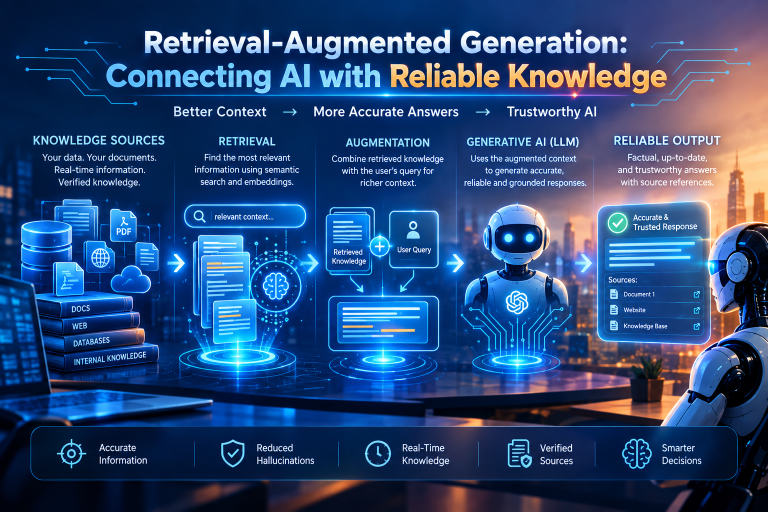
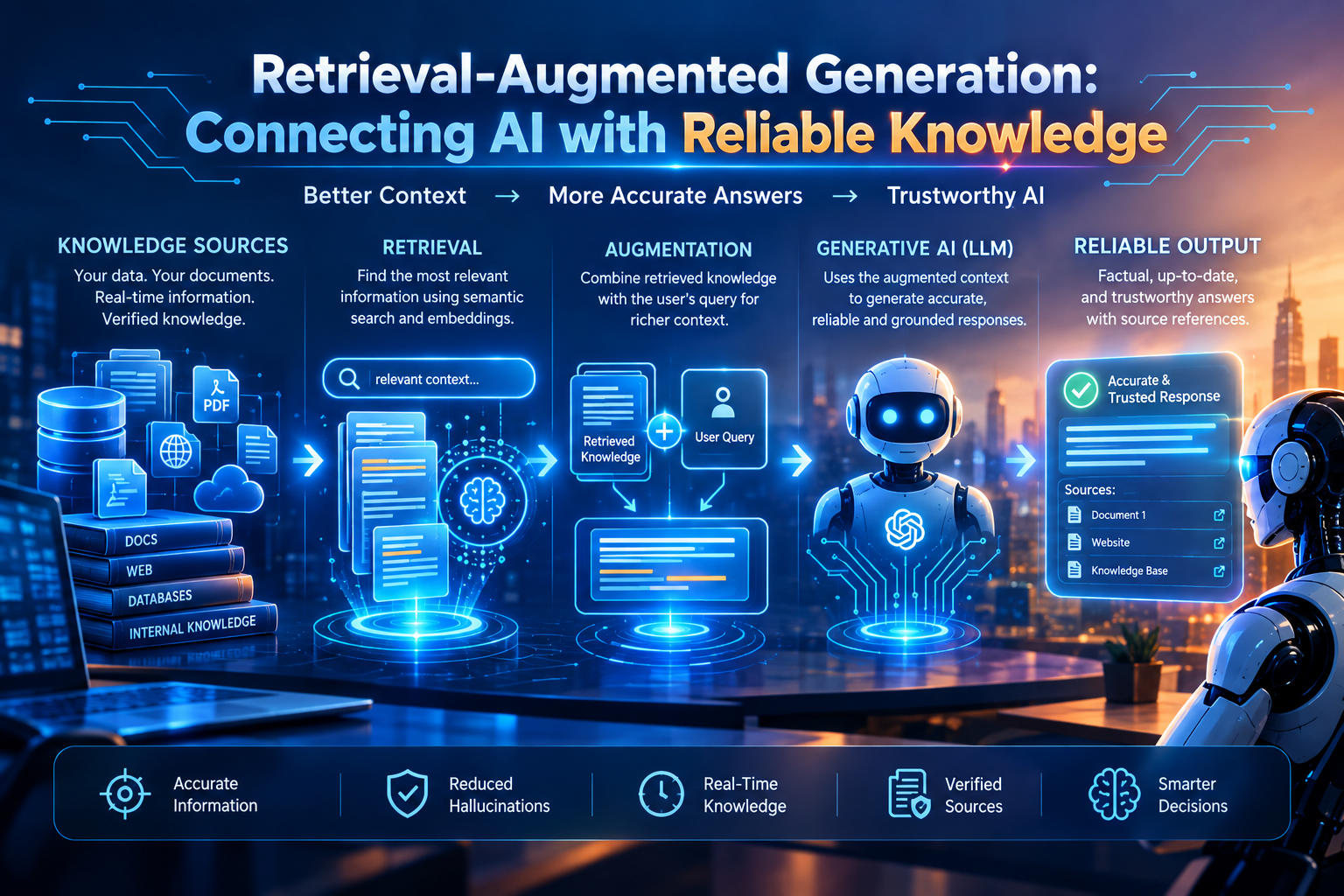
Retrieval-Augmented Generation (RAG) provides an architecture for addressing this problem. Instead of relying entirely on information encoded inside a model, a RAG system retrieves relevant information from external knowledge sources and provides that information to the model at the time of generating an answer.
This creates a connection between generative AI and external knowledge, allowing applications to produce responses that are more relevant to a specific domain, organization, or information repository.
Understanding Retrieval-Augmented Generation
Retrieval-Augmented Generation combines two fundamental capabilities: information retrieval and language generation. The retrieval component searches an external knowledge source for information relevant to a user’s request. The generation component then uses that retrieved information as context while producing the final response.
Consider an organization with thousands of internal documents, including employee policies, technical manuals, project documentation, and operational guidelines. A general-purpose language model may not know the contents of these documents. With RAG, these documents can be processed and indexed so that relevant information can be retrieved when an employee asks a question.
For example, when an employee asks, “What is the procedure for submitting a travel reimbursement?”, the system can identify the relevant section of the organization’s travel policy, provide that content to the language model, and generate an answer based on the retrieved information.
The basic workflow can therefore be represented as:
User Query → Information Retrieval → Relevant Context → Language Model → Generated Response
The important difference is that the model is not expected to answer entirely from its internal knowledge. It receives additional information specifically selected for the current request.
Why Large Language Models Need External Knowledge
Large Language Models learn patterns from the data used during training. This allows them to generate highly capable responses, but training does not mean that the model has direct access to every organization’s private information or continuously changing data.
Suppose a company changes its leave policy after an AI model has already been trained. The model cannot automatically know about that change. Similarly, a university may have internal examination rules that are not publicly available, while a software company may maintain proprietary API documentation that was never included in a model’s training data.
Another issue is that language models can sometimes generate information that sounds correct but is not supported by reliable evidence. This behavior is commonly referred to as hallucination. It becomes particularly problematic when AI systems are used for domain-specific tasks where accuracy and traceability are important.
RAG addresses these limitations by separating knowledge storage from language generation. The external knowledge source can be updated independently, while the language model can retrieve the latest relevant information when needed.
The Core Architecture of a RAG System
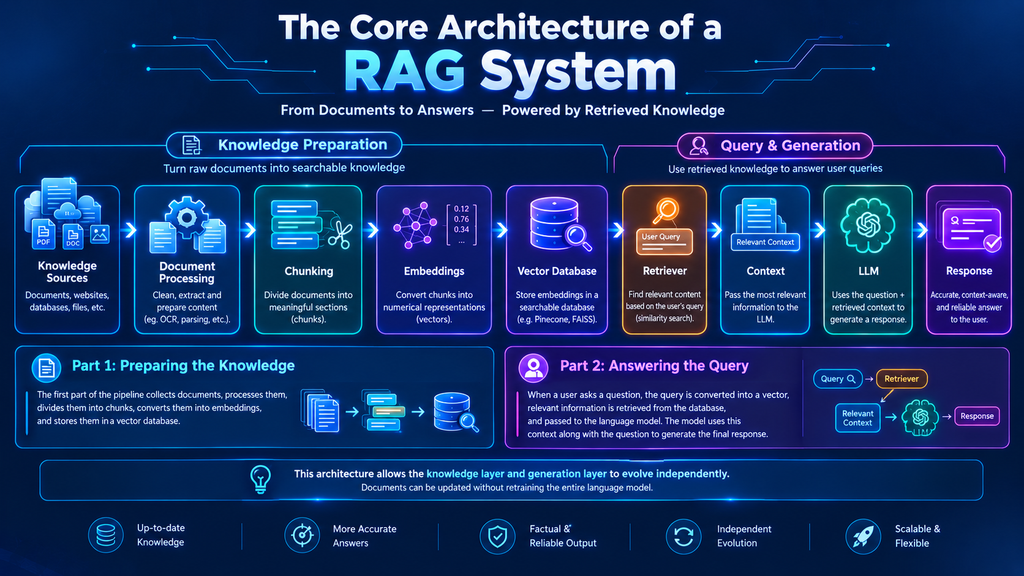
A RAG system generally contains several interconnected components. These components work together to transform raw documents into searchable knowledge and then use that knowledge to answer user queries.
A typical architecture contains:
Knowledge Sources → Document Processing → Chunking → Embeddings → Vector Database → Retriever → Context → LLM → Response
The first part of the pipeline is responsible for preparing knowledge. Documents are collected, processed, divided into meaningful sections, converted into numerical representations, and stored in a searchable system.
The second part operates when a user asks a question. The user’s query is converted into a representation that can be compared with stored information. The retrieval system identifies relevant content and passes it to the language model.
The model then uses the retrieved information along with the user’s question to generate the final response.
This architecture allows the knowledge layer and generation layer to evolve independently. Documents can be updated without retraining the entire language model.
Preparing Documents for Retrieval
Before a RAG application can answer questions, its knowledge sources need to be prepared. This process is often called ingestion.
Information can come from many sources, including PDF files, websites, Word documents, databases, product manuals, internal knowledge bases, research papers, and application-generated data.
Raw documents usually contain much more information than is required for a single user query. Therefore, the documents need to be cleaned and transformed into a format that can be efficiently searched.
During ingestion, the system may extract text, remove unnecessary elements, preserve document structure, identify headings, capture metadata, and prepare the content for further processing.
Metadata can also be extremely useful. Information such as document title, department, author, publication date, category, and access level can later be used to improve retrieval and security.
Document Chunking and Context Management
Large documents cannot always be passed directly to a language model for every question. They may be too large, expensive to process, or contain large amounts of irrelevant information.
For this reason, documents are usually divided into smaller sections called chunks.
For example, a 100-page technical manual could be divided into sections based on headings, paragraphs, topics, or logical boundaries. Instead of searching the entire manual for every query, the retrieval system can identify only the sections that are relevant.
Chunking is more important than it may initially appear. If chunks are extremely small, important context may become separated. If chunks are too large, retrieval may return excessive information that makes it harder for the model to identify the relevant details.
Modern RAG systems therefore often use intelligent chunking strategies that consider document structure and semantic relationships rather than simply splitting text after a fixed number of characters.
Some systems also use overlapping chunks, where a small amount of information is repeated between neighboring chunks. This helps preserve context when an important concept crosses a chunk boundary.
Embeddings and Semantic Representation
After documents are divided into chunks, the system needs a way to represent their meaning mathematically. This is where embeddings become important.
An embedding model converts text into a numerical vector. Instead of representing a document chunk only as a collection of words, the vector attempts to capture its semantic characteristics.
Consider these two questions:
“How do I change my account password?”
and
“What should I do if I need to reset my login credentials?”
Although the wording is different, both questions have a similar meaning. A semantic embedding system can represent these queries in a way that allows the retrieval system to recognize their relationship.
This is one of the major advantages of embedding-based retrieval. The system does not have to depend entirely on exact keyword matches. It can search based on conceptual similarity.
Vector Databases and Similarity Search
Once document chunks have been converted into embeddings, they can be stored in a vector database or another vector-enabled search infrastructure.
A vector database is designed to efficiently store and search high-dimensional numerical representations. When a user submits a query, the query is converted into an embedding and compared with the stored document embeddings.
The system then identifies the vectors that are closest according to a chosen similarity measure.
Conceptually, the process looks like this:
Document Chunk A → Vector A
Document Chunk B → Vector B
Document Chunk C → Vector C
User Query → Query Vector
The retrieval system compares the query vector with the stored vectors and returns the most relevant document chunks.
However, production RAG systems often go beyond simple vector similarity. They may combine semantic search with keyword matching, metadata filtering, and ranking techniques to improve retrieval quality.
Semantic Search and Hybrid Retrieval
Traditional search systems generally depend heavily on keywords. While keyword search remains useful, it may not always understand the meaning behind a question.
For example, a user may search for:
“How can I get money back for a business trip?”
while the relevant document uses the phrase:
“Travel Expense Reimbursement Procedure.”
A keyword-only system may not consider these expressions strongly related. Semantic retrieval can identify the conceptual similarity between them.
Many modern RAG systems therefore use hybrid retrieval, combining keyword-based search and semantic search. This approach can be particularly effective when both exact terminology and conceptual meaning matter.
For technical documentation, for example, a specific product name or API parameter may need exact matching, while the surrounding question may require semantic understanding.
Generating the Final Response
Once the relevant context has been assembled, the language model generates the final answer.
The model is responsible for understanding the user’s question, interpreting the retrieved information, and presenting the result in natural language.
Importantly, the model does not necessarily reproduce the retrieved documents word-for-word. Instead, it can summarize, explain, organize, or combine relevant information.
For example, a knowledge base may contain a lengthy ten-page policy document. A user may only need a short explanation of the required documents and submission deadline.
RAG allows the system to retrieve the appropriate policy sections and use the language model to produce a concise explanation.
This combination of retrieval + reasoning + generation makes RAG useful for interactive knowledge applications.
Advanced RAG Techniques
As RAG systems become more sophisticated, developers are introducing additional techniques to improve retrieval and generation.
Query rewriting can transform a user’s original question into a form that is easier for the retrieval system to search.
Reranking can evaluate multiple retrieved results and prioritize the most relevant ones.
Metadata filtering can restrict retrieval to specific departments, dates, document types, or user-accessible information.
Context compression can remove unnecessary information before it reaches the language model.
Multi-step retrieval can perform multiple searches when answering a complex question requires information from different sources.
These techniques demonstrate that modern RAG is becoming more than a simple “search and generate” pipeline. It is increasingly becoming a complete information-retrieval architecture around language models.
Enterprise Applications of RAG
RAG has become particularly relevant to enterprise AI because organizations already possess large amounts of structured and unstructured knowledge.
In customer support, a RAG system can retrieve product documentation, troubleshooting instructions, and support articles before generating an answer.
In software development, it can retrieve internal API documentation, coding standards, architecture decisions, and repository documentation to assist developers.
In research environments, RAG can help users search large collections of research papers, reports, and technical documents.
In human resources, employees can interact with organizational policies and procedures through a natural-language interface.
In education, institutions can build AI assistants that work with course materials, academic resources, institutional guidelines, and learning content.
The common principle across these applications is the same: the AI model becomes useful because it can access the organization’s relevant knowledge when needed.
The Future of Retrieval-Augmented Generation
The future of RAG is likely to involve increasingly intelligent retrieval architectures.
Systems may combine vector databases, traditional search engines, knowledge graphs, structured databases, APIs, and real-time information sources. Instead of retrieving only static text, future architectures can dynamically collect information from multiple systems.
Multimodal RAG is another important direction. Instead of retrieving only text, systems can work with images, tables, diagrams, audio, video, and other forms of information.
RAG can also become increasingly integrated with agentic AI systems. An AI agent may decide when information needs to be retrieved, which knowledge source should be searched, how multiple sources should be combined, and whether additional information is required before completing a task.
This creates a broader architecture in which retrieval becomes a foundational capability for intelligent systems.
Conclusion
Retrieval-Augmented Generation provides a practical way to connect language models with external and continuously evolving knowledge.
By combining document processing, intelligent chunking, embeddings, vector search, semantic retrieval, context construction, and language generation, RAG enables AI applications to work with information beyond what is contained within the model itself.
Its value is particularly evident in environments where information is private, specialized, frequently updated, or too large to be manually provided to an AI model.
At the same time, effective RAG requires more than simply connecting an LLM to a vector database. Retrieval quality, data preparation, security, access control, evaluation, latency, and knowledge freshness all play important roles in determining the reliability of the final system.
As AI continues moving toward more connected and capable applications, RAG is becoming an important architectural approach for building systems that can combine the language capabilities of AI models with the reliability and depth of external knowledge.
About the Author