
Introduction
Modern software applications are becoming increasingly complex as organizations manage growing numbers of users, larger volumes of data, and continuously expanding business requirements. Traditional software architectures often struggle to accommodate these demands when every application component is tightly connected within a single deployment structure.
Microservices architecture addresses this challenge through an approach in which an application is divided into smaller, independently manageable services. Each service is responsible for a specific business capability and communicates with other services through well-defined interfaces.
Rather than treating an application as one large software unit, microservices organize functionality into multiple services that can be developed, deployed, scaled, and maintained independently.
This architectural approach has influenced the development of enterprise applications, e-commerce platforms, financial systems, digital services, and large-scale distributed software environments.
However, microservices are not simply a method of dividing code into smaller components. They represent a broader architectural philosophy involving service boundaries, distributed communication, data management, deployment strategies, fault tolerance, monitoring, and operational coordination.
Understanding these principles is essential for designing software systems that remain manageable, adaptable, and reliable as their complexity increases.
Understanding Microservices Architecture
Microservices architecture is a software design approach in which an application is structured as a collection of loosely coupled, independently deployable services.
Each service performs a specific business function and maintains responsibility for its own operational logic. Services communicate with one another through defined communication mechanisms rather than depending on direct access to each other’s internal implementation.
For example, an e-commerce application may contain separate services for user management, product catalogs, inventory, orders, payments, notifications, and delivery tracking.
The user management service handles customer identities and account-related operations. The product service manages product information, while the inventory service maintains stock availability. The order service coordinates purchasing activities, and the payment service handles transaction-related operations.
Although these services contribute to one application, they can operate as separate software units.
This separation allows individual services to evolve without requiring the entire application to be modified and redeployed for every change.
The defining characteristics of microservices include independent deployment, clear business responsibilities, service-level communication, decentralized data ownership, and the ability to scale individual components according to demand.
The Evolution from Monolithic to Microservices Architecture
To understand microservices, it is important to examine the architectural approach from which they emerged.
Traditional applications were frequently developed using monolithic architecture. In this model, major application components are organized within a single deployable software unit.
A monolithic application may contain user authentication, business logic, database operations, reporting, and administrative functionality within one codebase and deployment package.
This approach offers several advantages, particularly during the early stages of application development. It simplifies initial deployment, makes local development relatively straightforward, and allows developers to work within a unified application environment.
However, as applications grow, the architecture may become increasingly difficult to maintain.
A small modification in one component can affect other parts of the application. Testing and deployment may require validating the entire software package. Scaling one heavily used feature may also require scaling the complete application, even when other components do not need additional resources.
Microservices emerged as an architectural alternative for systems that require greater separation of responsibilities and independent operational capabilities.
Rather than replacing monolithic architecture in every situation, microservices provide another option when application complexity, organizational structure, and scaling requirements justify distributed services.
Core Principles of Microservices Architecture
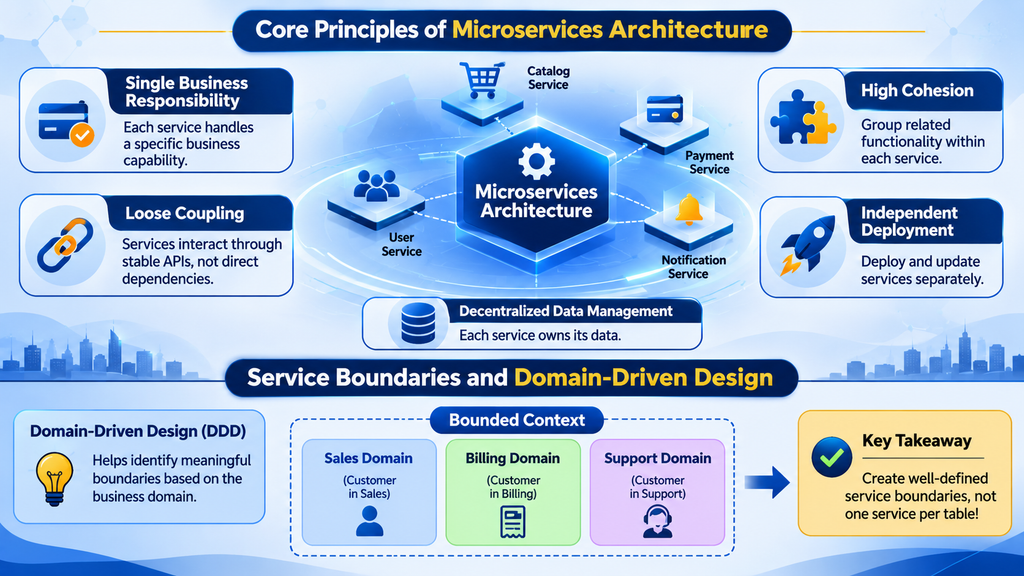
Microservices architecture is based on several principles that determine how services should be structured and managed.
Single Business Responsibility
Each microservice should represent a clearly defined business capability.
For example, a payment service should focus on payment-related operations rather than handling customer registration, inventory management, and unrelated reporting functions.
This separation creates clearer service boundaries and makes individual components easier to understand, test, and maintain.
However, a service should not be divided into extremely small components without a meaningful business reason. Excessive fragmentation can introduce unnecessary communication and operational complexity.
Loose Coupling
Loose coupling means that services should depend as little as possible on the internal implementation of other services.
A service should interact with another through a stable interface rather than directly accessing its internal code, database tables, or private data structures.
This allows individual services to change internally without automatically requiring changes across the entire application.
High Cohesion
High cohesion means that the responsibilities within a service should be closely related.
A well-designed service groups functionality that belongs to the same business capability. This improves maintainability and reduces unnecessary dependencies between unrelated operations.
Independent Deployment
A major characteristic of microservices is the ability to deploy individual services independently.
For example, an organization may update its notification service without redeploying its product catalog or inventory service, provided that the relevant interfaces remain compatible.
Independent deployment supports faster release cycles and allows development teams to manage changes within their respective service boundaries.
Decentralized Data Management
Each microservice should generally own the data associated with its business responsibilities.
Instead of allowing every service to directly access a shared collection of database tables, services expose controlled interfaces through which other components can request the information they need.
This approach reduces direct database dependencies and helps maintain service independence.
Service Boundaries and Domain-Driven Design
Defining service boundaries is one of the most important decisions in microservices architecture.
Poorly designed boundaries can result in excessive communication, duplicated responsibilities, and services that remain tightly connected despite being deployed separately.
Domain-Driven Design (DDD) provides concepts that can help identify meaningful boundaries within complex business applications.
DDD focuses on understanding the business domain and organizing software around its important concepts, processes, and relationships.
A central concept is the bounded context. A bounded context represents a defined area in which a particular domain model and its terminology have consistent meaning.
For example, the term customer may represent different information in a sales context, a billing context, and a customer-support context.
Rather than forcing every department to use one universal data structure, bounded contexts allow each domain to maintain a model appropriate to its responsibilities.
These boundaries can help identify potential microservices and clarify how different services should communicate.
The objective is not to create one microservice for every database table or business entity. It is to identify cohesive business capabilities that can operate with clearly defined responsibilities.
Communication Between Microservices
Because microservices operate independently, communication is necessary whenever one service requires information or functionality from another.
Communication mechanisms influence application performance, reliability, consistency, and overall system complexity.
Two major communication approaches are synchronous and asynchronous communication.
Synchronous Communication
In synchronous communication, one service sends a request to another and waits for a response before continuing the relevant operation.
HTTP-based REST APIs are a common example. gRPC is another communication framework used for structured, high-performance service-to-service communication.
For example, an order service may request inventory availability before confirming an order.
Synchronous communication is relatively straightforward to understand because the requesting service receives an immediate response.
However, it creates runtime dependencies. If the receiving service becomes unavailable or responds slowly, the requesting service may also experience delays or failures.
Timeouts, retries, circuit breakers, and appropriate fallback behavior help reduce these risks.
Asynchronous Communication
Asynchronous communication allows services to exchange information without requiring the sender to wait for the receiving service to complete its processing.
Message brokers and event-driven messaging systems are commonly used for this purpose.
For example, after an order is successfully created, the order service may publish an OrderCreated event. Inventory, notification, and analytics services can independently receive and process that event.
This approach reduces direct runtime dependencies and allows services to process work at different speeds.
However, asynchronous systems introduce additional considerations, including message delivery guarantees, duplicate processing, event ordering, and eventual consistency.
Monitoring and Observability
In monolithic systems, application behavior can often be investigated through a relatively centralized logging environment.
Microservices introduce a distributed execution model in which one user request may pass through several independent services.
Understanding the behavior of such a system requires more than collecting individual application logs.
Observability is the ability to understand the internal state and behavior of a system through the information it produces.
Three commonly used observability signals are logs, metrics, and distributed traces.
Logs record events and application activity. They help developers investigate errors, understand service behavior, and identify unusual operations.
Metrics provide numerical measurements such as request volume, response time, CPU utilization, memory consumption, and error rates.
Distributed tracing follows a request as it travels across multiple services. It helps identify where delays occur and which service contributes to a failure.
Together, these signals provide a broader understanding of application behavior.
Technologies such as Prometheus, Grafana, and OpenTelemetry support different aspects of monitoring and observability in distributed environments.
Security Considerations in Microservices
Microservices increase the number of independently communicating components within an application. Each service and communication channel must therefore be considered part of the overall security architecture.
Security should include authentication, authorization, encrypted communication, secure configuration, credential management, and controlled service access.
Service-to-service authentication helps establish the identity of communicating components. Mutual TLS can provide certificate-based authentication of both parties while encrypting communication.
Authorization policies determine which services can access specific operations or data.
Secrets such as database passwords, API credentials, and private keys should be stored and distributed through appropriate secrets-management mechanisms rather than embedded in source code or container images.
Network segmentation and access policies can further restrict communication between services.
Security also requires attention to software dependencies, container images, deployment configurations, and infrastructure permissions.
A distributed architecture should not assume that internal network traffic is automatically trustworthy. Each service should enforce appropriate security controls based on its responsibilities and the sensitivity of the information it handles.
Challenges of Microservices Architecture
Despite its advantages, microservices architecture introduces considerable engineering and operational challenges.
Increased system complexity: A single application may contain dozens or hundreds of services, each requiring deployment, configuration, monitoring, and maintenance.
Distributed debugging: Errors may involve multiple services, making it difficult to identify the original cause without centralized logs and distributed tracing.
Network dependency: Communication between services introduces latency, network failures, timeouts, and additional failure scenarios.
Data consistency: Maintaining reliable information across independently managed databases requires careful coordination and business-process design.
Operational overhead: Container orchestration, service discovery, monitoring, security, and deployment automation require appropriate infrastructure and expertise.
Testing complexity: Individual service testing is not sufficient. Integration, contract, and end-to-end testing are also necessary to verify interactions across the system.
Organizational coordination: Teams must maintain clear ownership, service contracts, and communication standards to prevent dependencies from becoming difficult to manage.
These challenges demonstrate why microservices should be adopted according to actual business and technical requirements rather than treated as a universal replacement for monolithic systems.
Microservices vs. Monolithic Architecture
Both architectures offer advantages under different circumstances.
A monolithic application can be easier to develop and deploy when the application is relatively small, the development team is limited, and business requirements are still evolving.
Microservices may be more appropriate when an application contains distinct business capabilities, requires independent scaling, involves multiple development teams, or needs separate release cycles.
The main difference is not simply application size. It concerns how responsibilities, deployment boundaries, data ownership, and operational processes are organized.
A poorly designed microservices system can become more difficult to maintain than a well-structured monolithic application.
For some applications, a modular monolith provides a practical middle ground. It preserves a unified deployment model while maintaining clear internal boundaries between business modules.
This can allow an organization to establish sound architectural separation before deciding whether independent service deployment is necessary.
The Role of DevOps and Automation
Microservices architecture and DevOps practices are closely related because independently deployed services require reliable development and operational processes.
Continuous Integration and Continuous Delivery (CI/CD) pipelines automate activities such as code integration, testing, building, security checks, and deployment.
Instead of managing every service release manually, teams can establish automated workflows that validate and deploy individual services.
Infrastructure as Code (IaC) allows infrastructure configurations to be defined and managed through version-controlled files. This improves consistency and repeatability across environments.
Automated testing, deployment approvals, configuration management, and monitoring help maintain operational quality as services evolve.
DevOps practices do not eliminate architectural complexity, but they provide processes and tools that help teams manage distributed systems more effectively.
When Should an Organization Adopt Microservices?
Microservices adoption should be based on the nature of the application and the organization’s ability to operate distributed systems.
It may be appropriate when different business capabilities require independent release schedules, when individual components have significantly different scaling requirements, or when multiple teams need to develop and maintain separate parts of a system.
It may also be valuable when an application has become difficult to evolve because of tightly connected business modules and deployment dependencies.
However, microservices may introduce unnecessary complexity for smaller applications, early-stage products, or systems with limited operational resources.
The decision should consider development maturity, infrastructure capabilities, security requirements, data consistency needs, and long-term maintenance costs.
In many cases, gradually extracting services from an existing modular application is more practical than redesigning the entire system at once.
Conclusion
Microservices architecture provides a structured approach to developing complex software systems through independently manageable services organized around business capabilities.
Its principles of loose coupling, high cohesion, decentralized data ownership, and independent deployment support application flexibility and controlled scalability.
At the same time, distributed communication, data consistency, fault tolerance, security, and operational management introduce challenges that must be addressed through deliberate architectural decisions.
Technologies such as Docker, Kubernetes, API gateways, message brokers, and observability platforms provide important capabilities for implementing and operating microservices, but they cannot replace sound system design.
The effectiveness of microservices ultimately depends on how well service boundaries are defined, how responsibilities are distributed, and how communication and failure scenarios are managed.
A successful architecture is not necessarily the one containing the largest number of services. It is the one that provides the right balance between independence, maintainability, operational simplicity, and the evolving requirements of the application.
About the Author