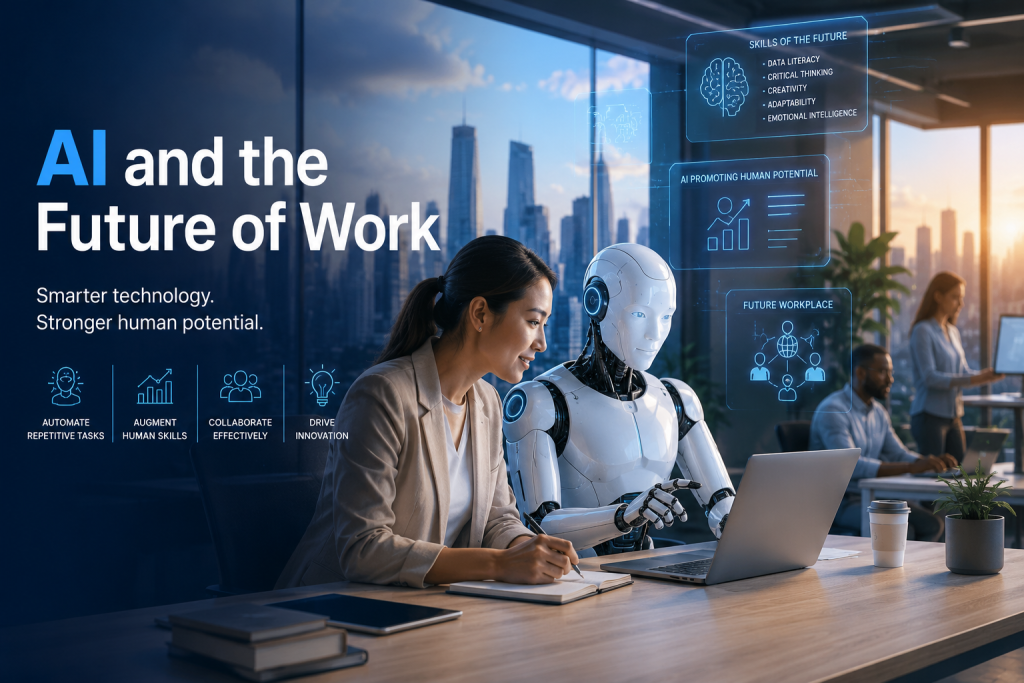
Artificial Intelligence (AI) has rapidly evolved from a futuristic concept into one of the most transformative technologies of the modern era. Across industries, AI is changing how businesses operate, how decisions are made, and how people work. Within the technology sector, its impact is especially significant, driving innovation while redefining job roles and workplace expectations.
As AI continues to advance, professionals in the tech industry are entering a new phase where success depends not only on technical expertise but also on adaptability, continuous learning, and responsible innovation. While concerns about automation are understandable, AI also presents exciting opportunities to create smarter workplaces and more meaningful careers.
The Evolution of Artificial Intelligence
The idea of machines performing tasks that require human intelligence has existed for decades. The formal journey of AI began in 1956 during the Dartmouth Conference, where researchers introduced the term “Artificial Intelligence” and established it as an academic discipline. Over the following decades, AI experienced alternating periods of rapid progress and slower development. Limited computing power and insufficient data often slowed innovation, creating what became known as “AI winters.” However, advances in cloud computing, high-performance processors, massive datasets, and machine learning algorithms have dramatically accelerated AI development in recent years. Today, AI powers technologies that many people use every day, including virtual assistants, recommendation systems, intelligent search engines, fraud detection systems, language translation tools, autonomous vehicles, and advanced healthcare diagnostics. These innovations continue to reshape industries around the world.
AI’s Growing Role in the Technology Industry
Few industries have embraced AI as extensively as the technology sector. Software companies, cloud providers, cybersecurity firms, and digital service organizations increasingly rely on AI to improve productivity, automate repetitive processes, and deliver personalized customer experiences.
AI is helping organizations by:
- Automating repetitive and time-consuming tasks.
- Improving software testing and quality assurance.
- Enhancing cybersecurity through real-time threat detection.
- Assisting developers with code generation and debugging.
- Providing predictive analytics for better business decisions.
- Delivering personalized user experiences based on customer behavior.
- Accelerating product development and innovation.
Rather than replacing every human task, AI is increasingly becoming a collaborative tool that helps professionals perform their jobs more efficiently and make better-informed decisions.
Job Transformation and Automation
Automation is expected to reshape many routine and repetitive roles. Certain administrative, testing, and support functions may require fewer human resources as AI systems become more capable. However, history shows that technological revolutions often transform jobs rather than eliminate them entirely. Professionals who adapt to changing responsibilities will be better positioned for long-term career success.
Closing the Skills Gap
Technology evolves rapidly, and AI is accelerating that pace. Skills that were highly valuable just a few years ago may require significant updates today.
Organizations increasingly seek professionals who understand:
- Artificial Intelligence fundamentals
- Machine Learning
- Data Analytics
- Cloud Computing
- Cybersecurity
- Prompt Engineering
- Automation Tools
- AI Governance
Continuous learning is becoming an essential part of every technology career.
Ethical and Responsible AI
As AI systems influence more business decisions, ethical concerns become increasingly important. Issues such as algorithmic bias, data privacy, transparency, misinformation, and responsible use of customer information require careful attention. Technology professionals play a critical role in designing AI systems that are fair, secure, transparent, and aligned with ethical standards.
Emerging Career Roles
The demand for AI-related professionals continues to grow. Organizations increasingly require experts such as:
- AI Engineers
- Machine Learning Engineers
- Data Scientists
- AI Product Managers
- Prompt Engineers
- AI Security Specialists
- Robotics Engineers
- AI Ethics and Governance Professionals4
These roles combine technical expertise with business understanding and strategic thinking.
Increased Productivity
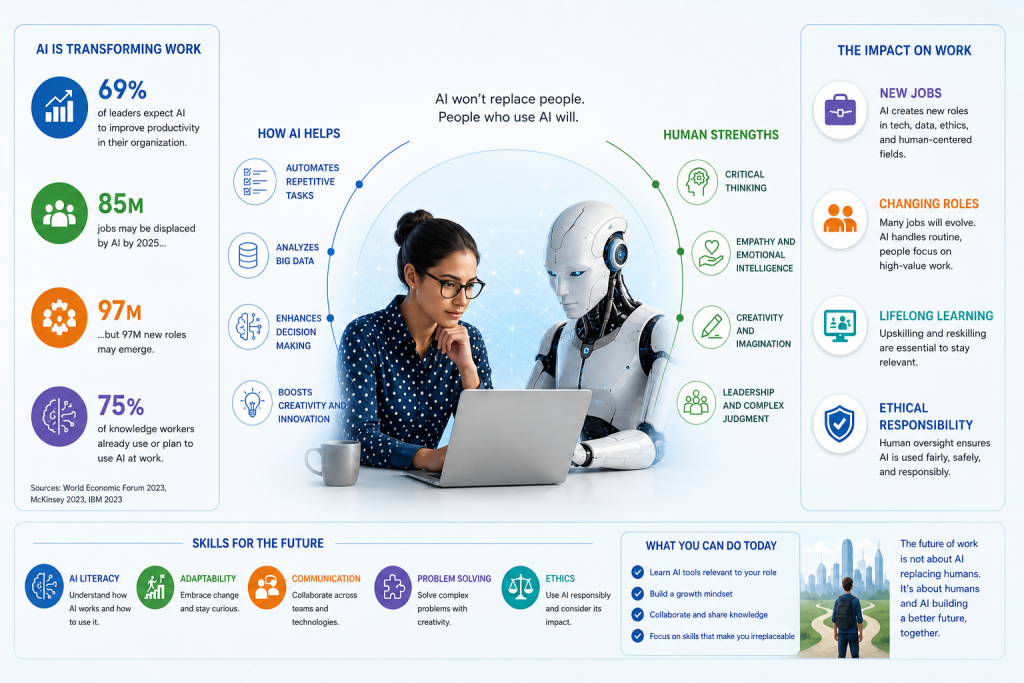
AI can manage repetitive tasks like documentation, data processing, report generation, and code suggestions, allowing employees to focus on higher-value activities including innovation, collaboration, strategic planning, and customer engagement. Rather than replacing creativity, AI enables professionals to spend more time solving complex problems and developing new ideas.
Human Skills Will Remain Essential
Although AI continues to improve, it cannot fully replicate the qualities that make human professionals unique. Skills that will remain highly valuable include:
- Critical thinking
- Creativity
- Emotional intelligence
- Leadership
- Communication
- Collaboration
- Problem-solving
- Decision-making
- Adaptability
Organizations will increasingly value individuals who can combine technical knowledge with these distinctly human capabilities.
Preparing for an AI-Driven Future
The future workplace will not simply consist of humans versus AI—it will be built on collaboration between both.
- Professionals can prepare themselves by:
- Committing to lifelong learning.
- Earning certifications in AI and emerging technologies.
- Staying updated with industry trends.
- Developing both technical and soft skills.
- Experimenting with AI tools in daily work.
- Understanding responsible AI practices.
- Building interdisciplinary knowledge across technology and business.
Educational institutions, employers, governments, and training organizations also have an important role in creating accessible learning opportunities that help individuals transition into emerging careers.
Looking Ahead
Artificial Intelligence is reshaping the technology industry at an unprecedented pace. While automation will undoubtedly transform certain job roles, it is also creating opportunities for innovation, entrepreneurship, and professional growth.
The future belongs to individuals who embrace change, continuously develop new skills, and learn how to work alongside intelligent technologies rather than compete against them.
AI should not be viewed solely as a replacement for human effort but as a powerful tool that enhances human potential. By combining technological advancement with creativity, ethics, and lifelong learning, professionals can build careers that remain relevant in an increasingly AI-powered world.
The journey has only begun, and those who prepare today will be well positioned to lead the next generation of technological innovation.